Winter solstice, the longest night of the year, December 21st, has often held religious significance, and for the homeless community, it is more poignant as the National Homeless Persons’ Memorial Day, begin 35 years ago and now growing.
Given the life expectancy of someone experiencing homelessness averages just 51 years according to a Univ. of Pennsylvania study, compared to the national average of 78, the community sees far more than a normal amount of death and grief. Moreover, very few people are remembered or celebrated in the same way that someone with a roof over their heads would be. The study published in HealthAffairs looked at 22,143 homeless deaths and found mortality sharply rose from 2011 to 2020. Co-author Matthew Fowle calls the 238% increase “astonishing.”
“It’s unlike any other mortality trend that we really see in demography,” Fowle told CalMatters. “It’s comparable to something like a natural disaster or war.”
Faith communities can raise awareness of those without housing in their community by remembering the day, and discussing the topic, just as one might mention the passing of a regular member of a congregation, synagogue, temple, or mosque.
“Creating greater access to ritual, memorialization, and opportunities to express grief and mourning are one critical way to give power back to people whose experiences are often overlooked. Public ceremonies are one way to expand the possibility of honoring fallen members of the homeless community,” said GRIP board member Jilly de la Torre, who wrote about memorialization projects for the unhoused community during her master’s program in social work at UC Berkeley.
“Many homeless people are intimately familiar with experiencing the death of loved ones in their communities. For people who are homeless and experiencing the death of another homeless person, there are often barriers to being able to access the rituals and processes associated with healthy grieving, such as memorial services, funerals, and burials, which are expensive,” de la Torre explained.
On that Sunday morning or in weekend services around Sunday, December 21st, recommendations include:
IN SERVICE:
- Light a candle and say words of acknowledgement, such as “We honor those from our community who died while unhoused, whose names we may not know, but whose lives we must not forget, each special and precious to their creator/Creator.”
- Leave a flower on the altar
- Read the names of people who’ve died while experiencing homelessness
- Include in prayer time a special prayer for those who died without a roof, whose names we may never know, but whose identity and humanity is known to God (substitute the appropriate reference for your faith tradition)
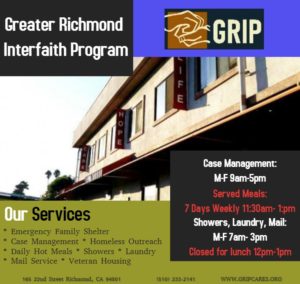
- Invite someone from GRIP or another homeless service organization to talk about the homeless with your church within the service, or afterwards in a small group
- Include a poem or reading. (Divided by a GRIP board member was read at the 2024 annual meeting.)
IN YOUR COMMUNICATIONS:
- Acknowledge it in the church bulletin, sharing the facts from this article or adding your own notes
- Mention the day and the death rates in announcements, or messages during service or on monitors and bulletin boards
- Share thoughts on your church social media
- Include details in your faith community email newsletters and website
For a how-to guide, more ideas, sample flyers, national event listings, a sample bulletin for a full service, please see the National Coalition for the Homless. https://nationalhomeless.org/wp-content/uploads/NATIONAL-HOMELESS-PERSONS-MEMORIAL-MANUAL.pdf
Share your event with the national group here: https://nationalhomeless.org/homeless-persons-memorial-day/